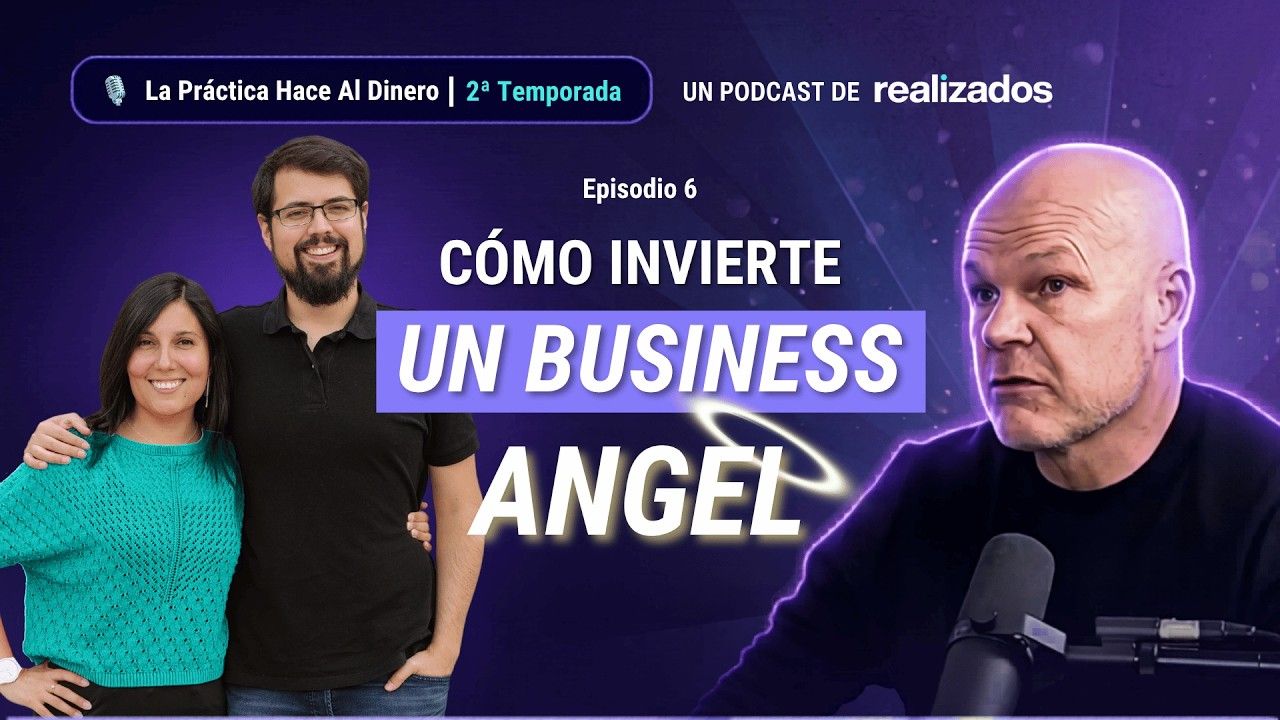
Podcast · T2 · E6
Los Secretos de un Inversionista en Startups
· 49 min · Con Jaime Medina y Natalia Espinosa
Escúchalo en tu plataforma
De qué hablamos
Hoy traemos un invitado que dirige un fondo de Inversionistas Ángeles para que nos cuente cómo empezó, en qué se fija y cómo se asegura de ganar en este mundo de inversiones tan arriesgado.
Puedes descargar las primeras 100 páginas de su libro en el siguiente enlace:
https://startupfundingbook.com
Jaime y Natalia entrevistan a Nicolaj, un inversionista que dirige un fondo de inversionistas ángeles y que, tras vender su propio negocio, invierte en empresas que están empezando. La entrevista es en inglés, con presentación y cierre en español.
Explica cómo elige en qué empresas invertir, cuánto capital hace falta, por qué hay que estar dispuesto a perder parte del dinero, cuánto tarda en recuperarse y cómo ve el impacto de la inteligencia artificial en los negocios. Son opiniones del invitado sobre una inversión de muy alto riesgo, no recomendaciones.
Puntos clave
- Un inversionista ángel (business angel) es una persona que invierte su propio dinero, normalmente en empresas que empiezan.
- Es una inversión de alto riesgo: según el invitado, en tecnología cerca de la mitad de las empresas no devuelven nada.
- Por eso recomienda repartir el dinero en muchas empresas; en Europa, a su juicio, con menos de unos 100.000 euros es difícil hacerlo bien.
- En una empresa que empieza, el fundador lo es casi todo: se fija en su motivación, su experiencia y lo que ya ha avanzado por su cuenta.
- Prefiere la tecnología porque, una vez creado el producto, producir más cuesta muy poco.
- La confianza es local: invierte sobre todo donde puede conocer a las personas a través de su red.
- Recuperar el dinero suele tardar entre 7 y 10 años; nadie puede prever cómo será la inteligencia artificial dentro de diez años.
Transcripción completa
Transcripción automática del audio: puede contener errores en nombres y cifras.
Hola, ¿qué tal? Te damos la bienvenida a un nuevo capítulo de La práctica hace al dinero y hoy día tenemos a otro invitado muy especial porque nos va a enseñar, no solamente a ti, sino que también a nosotros, lo que se trata el mundo de la inversión, de los inversionistas ángeles. Sí, la inversión en negocios. Hola Nicolaj, estamos muy felices de estar aquí con nosotros hoy to the people that we will learn with you what is a business angel so can you explain what is that yeah it's first of all a very broad word and it's a fluffy word and and i would say that it's basically first of all a private person who's investing and that is different from an organization or a fund so most of you who have like normal job have put some of your money into an investment fund and they can invest in all kind of include investing startups. But a business angle is opposite for that because a business angle is actually a private person like me who invests his or her own money. And then normally it will then be in companies. It could in theory also be that I invest in land or I don't know what I could invest in. But in general, it's in companies.
So the first two is it's private person investing normally in companies. kind of companies and again business angels are like if if you take 100 business angels they are different right different tastes of what they like um my area of expertise is mainly in technology companies and mainly early ones um but you can also have other business sales who will be interesting in investing in consulting companies or import export business whatever um but normally the term business angle is associated with persons who invest in like technology companies that are really in the early states. This is what I do. And then, of course, to make it even more complex, technology is broad. That could be software, it could be biotech, it could be robotics, it could be artificial intelligence. But in broad, private persons who invest in early stage technology-based companies. you are investing your own money. It's very easy to spend somebody else's money, but you're investing your own money in high-risk companies, but I think, or I suppose, that is expecting that that investment x or two x's for example it multiplies for how many for 10 for 20 and 20 30 yeah but but you're totally right um in theory you know investing my own money in technology companies could be me investing in spacex or something like that that is not early stage right that's a company that is 20 years 15 years old and have a lot of revenue and therefore it might be perceived as risky from the outside but compared to A new company, right?
So it's like investing in SpaceX 15 years ago. That was the best thing. At that point of time, I know Elon Musk put in most of his own money, but there was actually people there who said, of course, since he was famous, well, it's not a small amount, but there was a person who said, okay, here is half a million euro, a dollar, right? But it is very risky. But that is also according to economic theory why you can make money. that means that many will not do it. And then, as you said, there has to be an upside of not doubling the money, but putting your money 100x. So some of the most famous examples will be a business angel who put in $100,000 into Google, right?
Or a business angel who put $100,000 into Facebook. Yeah, Facebook was half a million, I guess, but still, that kind of amount. So you can minimize the risk, of course, betting on one company right so now i'm close to investing in 50 companies because you never know so you're sort of making like when what you do with normal stocks a portfolio i'm sort of doing the same i'm doing a portfolio to minimize the individual risk yeah and you just said some amounts that you can invest but if somebody is watching us and thinking maybe i can do this the same than you and how much money they need to start it's it's first of all it differs a lot from um region where you are in the world and also you can say what kind of company train if if elon musk calls you right or call you that's because he didn't need ten thousand dollars that's because he needs ten million dollars to build a rocket um so of course there's some there but i would say where in europe which is the area i'm mostly known to that and us i think business angle investments go from $5,000 and up sort of right because it's a company right so it's a company you try to fund and since you're going out to external people is because it's above what you have on your own but most of these investments are happening with multiple people so normally when a company you have a company and you reach out to business angle you will actually normally get the money not from one person for five or ten and in europe i think these investment rounds are normally from 100 000 euro or dollar and up and why not take 10 000 because it's for instance you or your business people you own right and you know there's a big difference between you own 100 of the company and beside everything and taking in external people so this is a huge step so you should actually only do it that's my advice if you can't avoid if there's some okay we can make this company or we can only make this company if we get the money or we can make this company 10 times bigger but only if you get the money and that's why it's normally not worth it if the amount is too small so to answer the question what would would it take in europe it'll be let's say 10 000 spread it across multiple investments to reduce that risk. So that would be multiplied with 10. So that would be my general advice, in Europe at least, is that below 100,000 euro it would be hard because if you have only made one or two, there's a huge risk that these two will go down and you lose all your money. Yeah, great advice. And when you say that, for example, the owner of the company gets the money of an investor, they give away a percentage of the company. So when you invest in these companies, you try to get more than 50%, less than 50%, and how much percentage do you earn when you get these stages?
I would say a few percent, and that's broad because it is broad. In general, professional businesses understand that it's still you who's running the company, And what has happened over time is that business angels and startups across the world have learned what it takes and have learned that what makes a company successful is actually you, not the investors. So in general, in a funding round, normally, and that is the rule of thumb, is that the startups sell 20% of the company. So that could then be 20% divided by business angels and each of us is having 4%. The majority works in stable big companies where you could replace you. So that means that you have a big company and if I have 50%, I can replace the two owners because the hundred good employees will still be there. But in a startup, that's not the case. If you decide not to leave the company, there is no company.
So my motivation is actually the opposite. Owners little, so you still think it's your company. Very important, because I know that in early stages the owner is very important because he has the idea, he has the vision, he has probably the knowledge to develop that. And when you invest in this kind of business, what are you looking for? For example, it's not the same a business A and a business B, because you probably try to choose, some checkpoints. For example, the team, the market. What are, for you, the most important aspects? The most important, as you said, is the team.
And that's because there's nothing. Even if you end up in a bad market or whatever, you'll most likely switch anyways. But then what is a good team? I think to summarize it, it'll be something about passion and skills. And it is so hard to build a big company. that um you need some extraordinary passion for that that can come from and i always joke and say most startup founders a little bit messed up in our head from childhood we have something we want to prove and and and we have all these stories and and i look for this passion and then why do they want to build this because they need to continue after year two normally it takes 10 years and it's really really hard especially the first five so why do you still want Is it because you didn't have money as a kid and you want to prove that? Is it because your old school teacher said you will never become something? I actually saw a quote the other day from an American venture capitalist who said, you know, there's only three good types of founders.
There's the one who are autistic. There's the one who have megalomania, you know, crazy drinks. And there's the one who wants revenge. your childhood doesn't have to be that but but why why is it and then the other side of course is that are you skillful enough to do that you know and of course what can you look for that what have you done in the past have you been successful in the past uh do you have the stamina do you what have you worked for or what have you studied and and also of course how far have you come on your own because most business things don't invest when you have an idea we invest when you maybe work on this for one year what have you managed to do in one year Have you just been thinking about doing it? Or have you built and got the first customers? And that's why it's like most of the companies I decide to invest or not invest in is actually in who are these people. So the people is important. Who they are is very, very important for this.
you also do some coaching for them to help them because maybe they have these two criterias but they don't have the experience probably or maybe so you coach them and it's because you have that experience yourself you did build a company before because I know that you used to work in like everybody else so you can tell us about your story I would actually go backwards and said actually one and a half year ago one and a half hour ago I actually had one of these sessions online with the founder. And he basically asked me, you know, it was very broad. And I come, first of all, I actually always start to be aware of, you shouldn't listen too much to people like us. Because my situation at my, the base on my advice is different from your situation. Because it might be the same industry I had my experience in, but maybe something that happened in 10 years. Maybe it's a different industry. Maybe my understanding of why my company was successful in the past is wrong but of course you you can learn and i i compared to building a house right i don't know if you remember in school but at least in northern europe when in school you had to go to woodworks and have to cut and build something right and you know like something like craft right and you brought this home to your parents right how good was it not that good because you only did it a few hours and it's like when if you build a company and i never build a company it's like you building your first house or later these tiles right can you imagine the first time we should lay these tiles it wouldn't be pretty so can you learn something from people who have laid tiles last 15 years i think you can learn something does make sense so so i'm trying to give some of these all advice um yeah my old story my own story is that i'm i'm from scandinavia denmark and have a very normal background and i i often always say that in scandinavia you're not real poor but i was relatively poor because i'm from a single mom who raised me and my sister and i think that has been part of the drive and i said it's no coincidence that my sister had built a big company right because what's happening all it's not like revenge but it's no more like we had we saw the lack of opportunity my mom had and that's why we want to i want to put me in the position where i don't need that so yes i like nice things but i'm in general not that materialistic my major goal in life have been to have enough money can provide for my family and do what I want to do and enjoy life and not have to worry about these things that my mom did. And then I went to the classic thing about went to school and university and had regular jobs for five years before I started, yeah, basically 19 years ago, my startup thing and start building the first companies and they were not successful.
But then I also made an investment on the way and that was sold in 2015. and this money, instead of buying an apartment or whatever, I invested into six other companies and then some of them were successful. And this money I then got over the last 10 years is basically what I now invest in startups. And that investment that you did and you sold in 2015 was the same, a business investment? Yes, a little bit different. It was actually ski goggles with heads-up display so with technology building and he's one of my best friends from denmark who went on to study in canada and he's a former competitive swimmer and he had this idea of building swimming goggles but then he would come to canada and met people and said no let's build ski because ski is first of all easier it's bigger it's outdoor no water and the market is bigger so he built a ski goggle brand with like electronics in that was sold to intel in 2015 and i and two other buddies were the first investors before business angels and all that. Actually, it's a fun fact. For all these reasons, I only started skiing two years ago, but I still had a first goggles from there from 2011, and these are only goggles I wear.
Yeah, so that's like sentimental value for me. Well, I have another question because, well, you talked about you had a regular job, and then you create your own business wasn't successful but then you get this found or you're this well because you have a little found too i think so you you have other people's investing but you are like the leader of this found one of them that are interviewing some businesses and evaluating and they say okay we will put our money here so what makes you more attractive to technology companies than other ones because probably other ones are easier to evaluate because i think in you need to have a very good vision of the future. Where is the world going to? Because if not, maybe technology is going to be obsolete in one, two, three years. And world in technology is changing very fast. So what makes you attracted to technology companies than other ones? Because technology broadly has what you in economic terms call economics of scale, meaning that your costs are diminishing, meaning that you can build really big, profitable companies. So the classic example, again, will be some kind of software.
The main cost is this, and I have the same cost, whether I have one customer or 10,000 customers. And that means that if you can build something that has these high margins and increasing margins, you can become really, really big. Unlike other companies that don't have that, selling if i was um producing tiles right most likely that's a very competitive market with low margins and i have this cost base and if i if i sell double i have you know yeah so it's hard to scale or grow these companies and that's what you can do with technology that's what you can do with software because the marginal cost of producing one more copy of this or running it even on the cloud so we all many using google right and i use gmail or google for all my things when google has one more customer on that platform what is the cost even per month a few cents right nothing or we could also talk about biotechnology right cost a lot of money to develop a new medicine but to actually produce medicine so if you look into the annual reports of pharmaceutical companies they sometimes place the of goods so what the cost to produce less than 10 and that is really putting they put all kind of thing in real life the marginal cost of producing medicine is most likely for many of these less than one or two or three percent so if you come to a company that have this you can build big companies and many of them will fail but it's not only for the financial reasons i think Honestly, most businesses like me, we shouldn't do it for financial reasons because it's risky, whatever. It's also what I think is fun to change the world. Not only to save people from cans or whatever, but you know, to change the world. Many of my companies are really small and they compete against big ones. But small companies, because these markets can actually, unlike in the tile business, small companies can actually, big one, right? You know, when Google started.
Sorry for coming back to that. But Google started. The few people at Google could outcompete all the big search engines. Do we still remember what Yahoo is? Or excite all these search engines, right? They can be outcompeted. And that's what I think it's fun. And I think it's fun to be part of that personal journey.
Let's say if you were two companies, two persons building a company, and I own maybe two or three percent, and I'm part of that. And then 10 years later, we celebrate it. interesting and it's rewarding and it's like the fountain of youth because you still now when i'm getting older i'm getting to work with younger and younger persons relative to me and they have the drive and they are naive and but i could also i'm actually right now also looking into more classic companies maybe not the title business because what's interesting is now you can take classic products and put technology in and you can say car industry 15 years ago, right? That was a classic industry with low margins because it was production cost. Now it's getting more and more into a technology, right? What makes you choose this car from this car? Is it the wheels? Is it the...
No, that has better navigation. That has better something that would suddenly software. Not that I have the money to invest in a car business, but to illustrate. trends is if you sit chairs right really unprofitable business to go into furniture a classic value chain where you have to go to shops and distributors whatever now many of them are saying hey why are you not just designing that on yourself online we put use it with a lot of robotics and we send a personal version to you maybe direct to consumer so you see that technology is also into all kind of other business if that makes sense In fact, I can see that you not just invest because it's profitable, because the business can scale, but also you are related to because you feel like something is like an emotional connection with that. So that's interesting. And also I want to ask you because many people want to grow their business, probably, and maybe they are seeing us right now. So if they want to and they want to reach some investors, what is the advice that you can give them if they want to start from zero to arrive at? I think the first advice is that since it's a people business, it's in 99% of cases a local one.
Because, to give the example, if you two were business people in Copenhagen or Denmark or most part of Scandinavia, I can find out 10 people who know you. I'll just call around and find out who you were so I have a picture of who you are it's like hiring people right everyone can fake it in half an hour but if I find 10 people that work with you I can find out what you're good at and what you're not good at and then many things we're all not good at but I can find out if you instead were calling me from France I couldn't because I don't have this network and that means that this trust and this opportunity to check who you are is local and that's of unfortunately if you are in a region or country where there's not that many investors i fully get that um but i think it's sort of that it's local and it's most investors invest in companies or industries they know a little bit of meaning that you if you have an if you in the online publishing of books or something like that most likely it's investors who know this industry if you want to sell furniture online, most likely it's someone who knows a little bit about e-commerce. Does that make sense? So these two variables are likely where you are geographically and where the investors have that knowledge from. And then the third advice is that you only need to find one lead. And that person will then introduce to others. So again, the few times I invested in countries where I have no network is because I have one of my investors who tell me hey i know this is in latvia whatever but you should really look at this team i'm going to invest so if it's an investor i trust if that makes sense yeah interesting the other day i heard a story very very powerful story that um an owner of a company was in britain uk and and he sold of the part of the company and he get he got sorry seven hundred thousand pounds yeah because it was in uk and when he got that money he doesn't didn't get the money the full money was for example fifty hundred fifty thousand sorry for him the owner perfect another one was for the company for just two expenses and the other one was a loan that was was in the money was distributed and the interesting thing was he said look i get a loan with a very bad conditions very bad like 30 40 percent interest per year but he said if i didn't get the money i haven't had the company that i had now and what did he do he do with the money that was for expenses he hired a person a very important person of one of the most biggest companies in the United States. And he said, I need you.
But when he was interviewing the person, he said in the interview was one question that discriminated if it approved the person or not. And it was, how many people can you introduce me of the other 500 bigger companies of the United States? Because I will hire you, but you need to introduce me. people because network is very important in this case so he chose one and after that he hired another one another one and then their team was a big team and he with the money and the money for the loan and everything he built a very successful company so at the beginning i thought that people sell your own company just because you are in a market time sensitive because you need the money now you can't wait for example two three years to get the money and then grow your business you need it now but now with that story changed my perspective and said it's not just time sensitive it's sometimes sometimes it's you need the the resources to get something that if you don't have you can't for example hire a person that probably will earn 300 000 per year at least because was in the in the in the chief board i don't know what is the name but chief chief I don't know what that is. So they need someone like with that profile. So now I can understand why people can sell the money because it's not just to get the money now. I think if I am an investor of that kind of companies, if an owner said, I need the money to go to holidays, vacations, say, no, no, I don't will give you money to that. I will give you money to grow your business.
So why? I don't know if there is another reason that people ask for the money. totally right up there can be of course be a time but but in technologies business are different right because normally there is this upfront cost to develop something develop is not only technology could also be a market position a brand so it's just like it's like zero one i simply can't i can't have this product unless i have one million dollar right because it's not like you know and if i don't have this one million dollar you know i need to have it so and that's typically in people's software but also in biotech and other industries right and of course there's also of course business where it's like the time thing right there is an opportunity now and i can't scale this company over 20 years i need money now so i can hire these people to do it yeah and i was thinking about uh the the people who used to invest they have different profiles for example there is a like no no risk and many many risks but uh behind all that What is the profile that you think that a business angel needs to enjoy the process, you know? Well, you need first of all to be okay with losing part of your money. Because when you invest in 10 of a business sale, if you do it in technology, five of them will go down where you get nothing. Then maybe three of them will be okay. years will be big winners and these two will pay for the rest and you can say with the time value of money so if the 10 years that's 1 million or 100 let's say it was 100 000 uh dollar would have to be in 300 000 worth in in um in 10 years right so basically you have these two companies where you invest maybe 10 000 in each has each of them to provide 150 000 two together well at the 300 if you see how the mat works and that means that first of all you will live from these two big winners and you have to be okay with the five that go bankrupt that's not because you did something wrong it's actually because you did something right because you can't have the upside if you can't have the risk and then the second thing you need to do is being patient and being okay not having these hundred thousand dollars that you have invested even though that two of your companies are worth a lot you can't sell the shares because it's not they're not listed on stocks so you have to wait until the company gets sold or something happens or get on a stock exchange in 10 years and then the third one is i think that's actually very important and i think it's not me who had invented that i think actually pop it we've talked about you need to have no fear of missing out Because there is a risk that you choose some of the wrong cases because, oh, all the other things are going into this now. And you need to be okay saying, yes, it seems like I'm stupid because I'm not doing it, but I can't make it work.
So I think all three are important. I think that would be my advice. But remember, you don't have to invest in technology business. You can also invest in another non-tech business that have fewer bankruptcies but of course also fewer that become really really big because if it is an import export company you are building it's hard to see you get the money back 30 or 50 times because even if this company grow five times in 10 years which is huge right maybe it's only worth five times the money in 10 years so it's just two different two different plays you can play do i want to play soccer or do i want to play tennis i'm not saying which game is a better one but it's you have to decide which game you want to be good at i have decided that that i like the technology thing and i like to have small investments in many startups my goal is to be in more than 100 in a few years and that means that you'll hopefully have a big pool yeah i think patient that you mentioned is something that every investor have to have you know a very good investor but uh how many years you have to wait uh more or less not on you know not not exactly for get a profit well in technology i think it's hard to estimate anything it takes time you can't really force it right it takes time yeah and and because it takes time for you to build a product and not customers to buy it and then you have to be big enough before someone thinks that that you're worth buying so my shortest have been five or six years and that is because someone else bought my shares after five years okay but normally i would say seven to ten and and that's also why i really recommend investing smaller amounts in many companies. Yeah. I would like to know your opinion about two things. One is AI. If it is important that companies now is including AI in the process and not just the process in the product.
And the other one is software as a service. That is a business model that the customer has to pay recurring fees. Because I think software as a service is exploding like a few years ago. is software as a service. For example, Microsoft, they changed before they sell, they used to sell Excel or Office, one payment. But now you have to pay every month. And what is your opinion about these two things, AI and software as a service? And if it is important for you, for your decisions, or if you say, no, it's not important, or maybe sometimes fits in a business model, sometimes not.
But what is your opinion about that? I think AI is one of these defining technologies that will become so big. And it reminds me now of getting gray hair, right? Like when the internet came, right? We could all see that it become big, but we had no clue about how big it will be. And it's a little bit the same with AI now. We know it's big, it's all ready. And it's really hard to foresee how big it will be, right?
Does general artificial intelligence, does that come? Well, it's like, we're not there yet um but it's just like it just changed all these things so yes it is important but it will be built in it's like it's again i was not here when electricity came right but it's like i'm sure there was some in the beginning who said we electricity companies right but now everyone use electricity like you do right and it's the same with with ai yes some are going to build a few companies in the world are going to build the brains you know the models um a few of them right because that's like designing a human brain. That's really hard, right? And then there'll be all these other companies who are going to apply AI in all kinds. And that will be the furniture company, right? That is most likely the software you're using. Most likely they're already using some kind of AI to fill out knowledge, right? That is all kinds of companies.
I'm sure there will be companies that have a small camera here and with AI can find out, you know, what's wrong with your plants and what your fish is, you know, sitting up here and finding out. whatever so it is already being built in everywhere right um and it's hard for us to invest us when we see companies position in different parts of ai because we don't know because the problem and the good and the bad thing now with ai is that everyone has access to the same tools so literally sometimes i see the same business id three times in a month okay we're going to use ai to do x month that means that in europe right now there will be 200 there'll be in the world there'll be 5 000 and then it's just like what is the chance that i have one of the real ones because it's it's suddenly too easy to build software and that comes back to software as a service software as a service have built the golden area for investors like me because we know if we could build some nice software you will never leave because you just like whether i sold to consumers also to businesses you will use it for a long time because we have this loyalty is hard to switch and hard to build and now it's actually getting easier and easier to build software with lower belong kind of tool and that means that okay if it's easy easier to build maybe then customers are getting less loyal because i can switch to something that is as good as yours for built by a new company that have 15 employees you know who can compete and so software as a service will it still be yes but it's more like how much of the existing revenue from the big players will be eroded by small ones so if you are a company and you use a cm system like salesforce right all these different modules whatever most companies are not using all these features most are using the small one so you're used to paying 10 000 a year to salesforce now suddenly a new company is saying we can build all this for you thousand dollars might be still software as a service but i think many of the big ones are being challenged by new players because it's getting easy and easier to build in fact i'm developing an app i don't know if you know but i'm developing an app about procedures how to write the procedures and get the procedure share the procedures because it's not easy i try to use in our I had a problem I said I have to solve it and I didn't find anything else so I built it or I'm in the process but in this process somebody told me once you need to get in some point AI because now if you don't have AI to like it's not high value it's low value but I try in to figuring out how or where should I put some AI and in one my first thought was well people can write like a draft of the procedure click the button AI and they get the procedure better but the problem is you need for the AI to create a good procedure they need or it needs the knowledge about the the company, the knowledge about what are you doing to give you a good procedure. But it's not going to happen because you have to train the AI and how you train it when you are starting to create your own procedure. You can't share your own training AI with another company because maybe it's going to be a leak of information that could be sensitive. So I don't know where, and that's because I asked you the importance of AI, I think sometimes in some markets, in some services or products, maybe AI is overvalued. Well, I totally agree. And I think many investors, of course, in the beginning was maybe looking more for that, but people are now getting more cynical view on AI, right? Yeah, AI can replace all our customer service agents.
No, it can't, but maybe it can create answer 70%, right? So I think, and of course, there's also instances where you don't need to use AI, but also remember, AI is more than the LMMs we're seeing. It's more like when you talk about AI right now, people think that, oh yeah, that is the LMMs we're seeing. But I think the most important thing of AI we haven't seen yet, and that is what a lot of companies are building right now, that is basically robots understanding the world. Because with the LMMs, we had robots understanding the words, but no context. And now you have robots understanding what is going on in here. So you can actually, with computer vision and all this, give me a cup of coffee, right? Because I actually know where the coffee machine, they can find out how to operate that.
So right now, I think we're still in fancy because we're basically using mostly, or most consumers, we're using the large language models that have all these limitations. I'm sure the new, like these world models will have the same, but that will be interesting. I'm investing also in one robotic company, but not many of them. about all these robots for the last 20 years. And it's really not been the mechanics that have been the barrier, right? But there's some details like understanding or the hand, right? How can I take this cup without crushing it? So I think to answer the question, yes, there are many places.
You shouldn't just apply AI to apply AI to make someone happy. But I think in general, there will be AI. But it's not only what we see here as consumers. I don't know if you know about alpha-thold, about this. That was getting really nerdy. But molecules, how they are structured means how they work. And some of these you have not been able to modulate in computers. And that means that when you have to test new medicine, now it's getting really simplified.
You actually have to test hundreds of thousands of different compounds to find out which one might work. And you did that in ptdysis, whatever. And one of the main problems was this. how proteins are folding and now with another type of ai you actually find out how they do and that means that you can basically say to the computer i want this compound that should do more than that so instead of testing 100 000 molecules you're testing 10 or 20. and i just think everywhere you look at it's yeah and that's also then the next thing will be what's happened with ai is that we'll consume a lot of power right and that means suddenly that this who can produce the most power the cheapest would be winners right yeah so i think it has a lot of implications sorry that was a whatever but but ai is interesting and we again anyone who claimed that they have can can see how this looks under 10 years i think they're bs because it's like asking you before chat gpt was launched no one of us could really understand then we had this moment and most likely there will be two or three or five or ten of these moments over the decade where suddenly oh my god yeah the vision is very important not just for i is but for every investor you know viewing because we talk about patient we talk about time it's a long time not long but you know medium or long time and well we are really happy to have you here thank you for everything but i have a last question for you that is for the people because many people i remember when we start our business We thought that we have a lot of problems with money because we start ourselves without money, without investors. We put our own money in this. And I thought many, many cases that many people didn't have the money for themselves, but they had great ideas. And I think that many great ideas lasted every single day because they don't have money.
is a lot of money in the world a lot of people with money that want to invest not to do a business but invest in their business so i think that this is like the light of hope to all that kind of ideas that is losing every single day because they think there is no money so you are the proof that is money in the world that wants to be in the right place with the right idea so that's a great great job that you have like not that job but you know what i mean well i think it is it is Yeah, well, for sure, it's a job, for sure. You have a lot of work. So thank you to be here. And if there is something else that you want to say to the people or just... No, I think entrepreneurship or starting companies is one of these wonders that when you have done it, it's not for everyone, because it is a very different path than being an employee. You know that. But I think it is so fulfilling in many ways that it's not only about the money but also about all the things you have to learn right because if you have a normal job in a big company you normally put in one of those boxes so you work in this box well you know that yourself right if you have what you're doing you have to learn many many different skills and i think it's rewarding in so many ways i really think that if you put a scanner on a person's brain before they started the first company and two years after i really think you will see that the brain has evolved because you need to learn new things so that's why i think that if if if people have the dream of starting a company start something they can be small right and finding out if it's something for them and i think it's really worth it in in many ways yeah nicolai have you written a book about this this topic yeah i've written a book called it's actually very boring because it's called startup funding book so it's very boring and that's actually about how startups can get and actually if you go to that startupfundingbook.com you can download the first 100 pages for free and now i'm in the process of writing another book on the other perspective that is how do you invest as a business angel and that's also about challenging right because that's also about when you're not a natural author it's actually very hard to write a book but that's why i like because it challenges you great great so people can read one thousand no 100 100 pages 100 pages for free and it's amazing yeah we will let the link below to reach your book. And well, that's I think our time for today.
But we are very, very grateful because you came, because you share your knowledge and your experience with us and with them. Y esperamos que también tú hayas disfrutado de la entrevista. Es difícil hacer esto en español y luego cambiar al inglés. Esperemos que hayas disfrutado de la entrevista, que esto te haya aportado un montón de conocimiento acerca, no solamente de cómo se mueve el dinero en el mundo, sino que también cómo puedes tú crear valor para alguien que tenga el dinero para financiarte. Así que, como digo, si las personas quieren crecer financieramente hablando, siempre se puede. Así que nos vemos en un siguiente episodio de La práctica hace al dinero. Muchísimas gracias, Nicolaj. Thank you very much.
Nos vemos. Adiós.