
Podcast · T2 · E7
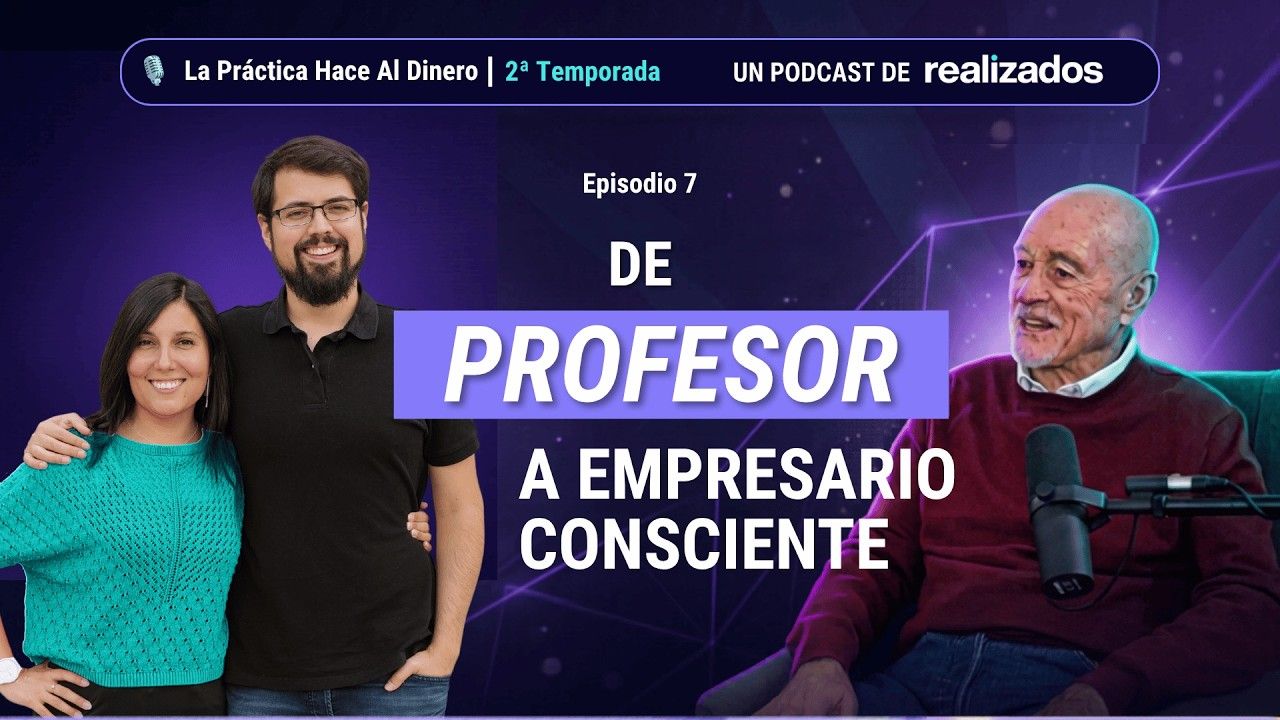
De Profesor a Empresario Consciente
· 54 min · Con Jaime Medina y Natalia Espinosa
Escúchalo en tu plataforma
De qué hablamos
Hoy conocerás la historia de Brendan, un profesor que creó un empresa de más de 450 empleados en un rubro que pocos se atreverían a explorar.
Jaime y Natalia entrevistan a Brendan, amigo y mentor de negocios de Jaime, que pasó de profesor a dirigir una empresa de atención a jóvenes con cientos de trabajadores. La entrevista es en inglés, con presentación en español.
Cuenta cómo dio el salto dejando un trabajo estable, cómo construyó el servicio poco a poco, el caso que cambió su forma de trabajar y qué piensa sobre la pasión, la integridad, el beneficio y la relación entre dinero y felicidad. Son la historia y las opiniones del invitado.
Puntos clave
- Brendan empezó como profesor y creó con su pareja un servicio para jóvenes en situación difícil, en una casa rural de Gales.
- Lo gestionó durante unos 35 años y lo vendió a los 70, cuando tenía unos 450 empleados.
- No empezaron un negocio, sino un servicio: el dinero llegó como consecuencia.
- Pronto aprendió a asociarse con quienes hacían las cosas mejor que él.
- Un momento clave fue preguntar a un joven qué necesitaba para cambiar, algo que casi nadie hacía entonces.
- Para él, la integridad es cumplir lo que dices o avisar a tiempo cuando no puedes.
- Ganar dinero no es malo en sí: cree que el dinero amplifica lo que haces y que se puede «votar» con él al gastar e invertir.
Transcripción completa
Transcripción automática del audio: puede contener errores en nombres y cifras.
Hola, ¿qué tal? Te damos la bienvenida a un nuevo capítulo de La práctica hace al dinero. Y hoy día tenemos un nuevo invitado muy, muy interesante. De hecho, para mí es un invitado muy especial porque es un gran amigo nuestro. Pero no solo eso, sino que también es mi mentor de negocios. Tiene una tremenda historia. Aquí está Brendan, nuestro amigo. Así que Brendan, estamos muy felices de haberlo aquí hoy.
Gracias por invitarme, es bueno estar aquí. Okay. So I was originally a teacher, then a social worker, then a psychologist and a therapist. And I ran a special facility in the UK for young people who were very difficult to work with. So they've been sexually, physically, emotionally abused or homeless or drug addicted parents or somehow in a dysfunctional family. and they were in the care of the local authority. And because I used to do that kind of work, I didn't like it because I think the children didn't get what they needed from it. So we started a private company, which was quite unusual in those days.
This was in the 1980s. Anyway, in 1985, we started this on a little farm in Wales, which is an adjunct to England. We were in the hills, just near the mountains. And we began that with just one person, my wife at the time and me. And anyway, we ran it for 30 years, in actual fact, 35 years before I thought enough of that. I was 70 years old and we sold it. And we started, and I think this is significant, we didn't start a business. We started a service for these young people.
is to local authorities, to government basically. They complained about the price, but we did it anyway. And after years of doing that, eventually you run out of energy. I was 70 when I ran out of energy. So we had a good time there from the 45 years that I had, I beg your pardon, the 35 years that I had when I started to 70. So it was a long time and it was time to stop. surprise it had grown in value a lot I know you talk about compounding well this was like compounding energy rather than actual money although we were getting money from the government and when it came time to sell the business we sold it for much more money than I thought we ever would and because I wanted a different lifestyle and not to pay too much tax to the and UK government, we moved to Andorra, where you only pay 10%. And then you can enjoy the fruits of your labors for years previously.
And I didn't become interested in business until we were maybe 10 years old. I used to wear overalls and muck out pigs with the kids and ride horses with them, feed the chickens, grow the vegetables, all of that sort of thing. And I was more interested in that. But I had to become interested in business because we started making money that needed to be accounted for and justified as well. Anyway, we did that. And I took on business partners because one of the things I learned very early on is there's always somebody that can do it better than me, whatever it is. And I adopted that. me.
The first one left because I wouldn't let him do the job. I was on his shoulder. And after that, I learned the lesson that you appoint somebody, you pay them a big salary, let them do it. And that took a while. Well, amazing story and resume about your life. I don't know if the word is resume. No, it's like... I used the same when I was talking with Brendan.
It's not like resume, it's like an excerpt, I think. Una historia sobre mi vida, pero básicamente es mi CV, Curriculum Vitae. Es lo mismo en español. Pero hablaste de algo muy importante, creo. Cuando empezaste el negocio, estabas 35 años. Tenías una familia en ese momento. Y tenías un negocio sobre algo muy complicado. no es fácil trabajar en un espacio social de trabajo, por ejemplo con niños muy malos, como mencionabas, emocionalmente, físicamente, o quizás no para ellos, pero el ambiente no era el mejor para ellos, así que creo que cuando empezaste, puedes corregirme, pero valientes más la misión y el objetivo que el proceso, Because I can imagine that the process wasn't so soft.
To move children or a child from that environment to be part of the social, again, support, the community, again, and heal him or heal her, it's not an easy process. And you say, okay, I will solve this problem. I will do this company. particular way because you were doing something that maybe the government has to take care about it and you did it by private but how was that process when you started you had an idea but when you leave it how was the process well governments aren't very innovative if you don't like what they're doing then do something different and that was my perspective at the time and also i was 35 i thought i could do anything and People don't. My entire family said, why are you giving up a job for life? Which is probably becoming a thing of the past now. But a job for life, a pension, security. You've got a wife.
I had three children at the time and one on the way. And yet we sold our house and we used that money to go to banks and say, please lend us some more. And almost everyone said no. because I had no experience. No business plans at all? I did have a business plan. It was about the size of a cigarette packet. It was very small and I knew very little about business.
I knew nothing about borrowing money. My education in managing money was from my mother, who never spent a penny more than my father earned. And that was a very good grounding in in the way money was at that time. It may not be so good today. You hear people telling you, borrow as much as you can and then die, which I'm not particularly interested in doing. But people, things change over time. Anyway, we went to Wales. We sold our house.
People, because it was what I thought was a good idea. So I was passionate about it. And when you're passionate about something, you can transmit that to other people. I asked somebody to help me find money and his mother loaned me money. I went to a farm in Wales that they couldn't sell for four years because it used to be a really big farm. And now it only had 13 acres, which was perfect for what I wanted. It had a big house. It was cold and damp.
price and I managed to borrow all the money even my mother-in-law who didn't really like me she loaned me some money and my wife at the time was a saint she she was willing to sell our own house to raise the first little bit of money and it was a little bit because the house was mortgage and so there were a set of circumstances that in no way supported starting a business but we did and we down there and we took the very first child who funny enough for his surname had exactly the same name as my first name Brendan so he was called something Brendan I won't mention names but anyway and then a kid did us a great favor and he set fire to the house only 18 months after we started which was a real gift because it wasn't for him so much but nobody got hurt the house did burned out, but it was a 250-year-old house, so the walls were like this thick, but there was no insulation, they were cold, it was damp, and we rebuilt a new house inside the old one, and we also converted buildings adjacent to the house that were farm buildings, very good old farm buildings, and we built new accommodation in there for the children and the staff who lived in to look after them. So that was a very early, it looked like a chaotic mess to begin with, and it was, but it actually was a great gift and we took it like that. And after a few years of looking after children, in the way that I'd been taught to as a teacher, as a social worker, as a psychologist, as a therapist, I thought we're not really doing a very good job. I had promised local authorities, if we take your child, and these were the most difficult children in the United Kingdom, and we won't give up. Anyway, there was one lad who was very violent, very aggressive, would hit people almost daily, and didn't want to engage in anything. I mean, we'd had him for about six months, and it was coming to the point where the staff were pleading, brethren, we've got to say no, and I didn't want to do that. We went on like that for ages and it didn't get any better. So I had to phone his manager.
He didn't have a social worker. He was so difficult. He had the manager of the social workers. And they couldn't do anything with him. I knew that. But I went to the phone and said, look, I'm sorry. I'm going to have to break my word. And we're going to have to expel this boy.
Anyway, I said, the manager pleaded with me to give it a day, sleep on it. and see. So I said, okay, I'll do that. I went back to Poland the next day. The kid met me as I crossed the yard to the office. He said, you're going to kick me out, aren't you? I said, what can I do? Everybody feels unsafe here and we can't go on like that.
And suddenly out of nowhere, I just asked him, what would it take for you to stop hitting people, arguing with people every day and not engaging with the process and he had an answer like that and that amazed me because nothing in my education as a teacher as a social worker as a psychologist and as a therapist not one of those professional qualifications suggested I should ever ask a child what would it take and I did it and he gave me an answer immediately and funnily enough we're sat in the middle of the mountain that he asked, could he climb? So he said, I want to climb from the Atlantic Ocean along the Pyrenees that we're living in and end up in the Mediterranean Sea. And I said, that's interesting. Well, if you would agree to some conditions and I can find somebody that's willing to go with you, would you agree? And he said, yeah, yeah, don't kick me out. And so anyway, that was the key point. We discovered something. Well, when I say rediscovered, I didn't discover it.
I just asked a question and he gave me an answer. Now, traditional childcare in the United Kingdom in the mid-80s, mid-1980s, had not changed basically since the Victorian times. Even earlier than that, where children in those conditions were kept in poor houses and then in special schools and in something that used to be called borstals before they were 18. So it was quite revolutionary to ask a child what to do. I didn't know that at the time. I asked it out of desperation, not out of any, I can't claim any credit for that. Anyway, that made a huge difference because we did the project. It took three months.
I found one member of staff who had just, it was all very lucky because one home had just closed that was therapeutic. And I met a member of staff and he was really good. So we employed him to go with this kid, let's call him Jim. And he took Jim. Jim got arrested on the first day in France for stealing a bicycle. He threatened to stab the member of staff he was with and he couldn't sleep for three nights. They were in separate tents climbing mountains. And to cut a long story short, it was immensely successful beyond our expectations when I went out to meet them at the end of their journey almost he wasn't hitting anyone he was engaging fully and so he was just a different human being and he came back and we carried on with the one-to-one work with him then I started asking all of the children one-to-one questions what would it take and they all had an answer every single one so kids in Colombia kids in Australia, kids in various countries in Europe, kids in the United Kingdom, kids in Ireland and I would visit them all at some point during their treatment but it was always for three months and it was always to make a program around them so that they got better.
I'm going on a bit now, aren't I? But anyway, it was something that changed what we did completely and it was simply asking a question and that's the important bit of it for me. We asked question that I'd never heard anybody ask me as a child, ask anybody else that I was aware of as a child. And I think that passion comes out of wanting to do something that actually makes a difference. And I think you can translate that to anything at all. Yeah, passion is a healing force. For example, for you, the passion was the action that moved to create the business. And for the kids the children the passion was the the thing that maybe i don't know if all of them but i think most at least of them heal themselves so the the passion for example this kid named jim was that and after they he did it he says i'm a new person and was just one one thing and it's very important i think to find your own passion not just for healing something just for living, because for you was a change too.
You changed your work for passion and you changed the children's lives for passion, for their own passion. Totally. And it didn't happen immediately. I was replicating what I'd previously done for the first five years. It was only after the sixth year I began asking that question out of desperation, not creatively, not want to send someone away and it's important to say that we weren't even creating a business and this is important i think we were creating a service and the money just followed i think the universe is absolutely waiting for you for me for anyone to come up with something that's a good idea for everyone in the picture so it was It worked for the local authorities. It worked for the parents who couldn't parent. It worked for me and even my family, despite the fact that Mox families would not have put up with what we did to begin with. And it worked as a service first.
And the money just followed. And this is really important. Even when we quadrupled the cost by agreeing to send kids to Colombia, Australia, France, Spain, Portugal, Ireland, all over the place. That costs money and I never bothered about the money. I just thought, and I used to ask questions, I said to the directors of local authorities, would you do it for your child? Of course the answer was always yes. And that's the basis on which we worked. It was unrealistic.
It wasn't my original idea. de un hombre distinto que me decía exactamente lo que quería hacer y entonces cada persona tenía exactamente la misma respuesta a la misma pregunta, pero obviamente en diferentes lugares y en diferentes formas. Así que, de nuevo, lo importante fue que no fuéramos de dinero, fuéramos de la calidad de servicio y eso fue lo que hizo la diferencia. cosas de las empresas o de ganar dinero, siempre se relaciona a tomar el beneficio, a tomar avance de algo. Pero estás hablando de algo diferente ahora, con tu experiencia. Empezaste con algo que quieres, quieres cambiar, quieres hacer valor para la gente, para el mundo y luego el dinero te sigue. Así que creo que esto es muy importante y quiero decirlo. People think that making money is something bad or you need to do bad things to get it.
But that is not always the case. You're an example of that. Well, there's nothing wrong with people wanting to make money. Many of my friends set out to make money and they did a good job. I think it depends on how you interpret your place in the universe, in this world. out just to make money but money is nothing except an exchange of energy in my view so if i want to exchange energy so i was giving my energy to those kids and they were actually giving it to me in various and some not so legitimate ways and the universe has a way i think of conspiring to assist you in doing something good that other people So I know what you guys do is help people to manage money and to increase their wealth. And I think that's a good thing to do, so long as nobody is being hurt in the process. And whenever that's the case, I think it wouldn't matter if I was a miner, a woodworker, a factory worker.
conspires to assist in that so loans come from nowhere people want to contribute to it the right people show up at the right time to work with you and the right opportunities come and some challenges come it's not necessarily all easy because people will disagree with what you're doing people will say they'll do something and then they won't do it which really important thing to have if you're aiming to succeed in anything. You've got to have integrity. You've got to do what you said you will do. And as we know, you've got to do it by the time you say you'll do it. Or if you can't, you've got to announce, I can't. And I've changed my mind about that. It's not actually my definition of integrity. I learned 30 years ago.
And it's very important because then people can trust you and trust your word. And I was thinking about the way that you did. I mean, you started a business with not a clear view of how it finished at the end. No, you were just starting. And you did a leap of faith. Not just you. Many people around you, even your mother-in-law at that time, gave a leap of faith for you. Even?
And what do you recommend to people? I mean, do you think that is a good way to find your passion, your path to give something to the world? In your case was that, in our case is financial education, but anything, if you don't harm nobody, you know. But find that, and after that, trust with a leap of faith, or you now, with your experience, believe that you need something like preparation or something behind us. You know what I mean? In your experience, you did a lot of leap of faith, like a lot of faith on there. And everything went good. Not, you know, you have challenge and things.
But at the end, you have a good story. And you did with faith. But do you recommend the same to somebody who's starting now? Well, it's not just faith. There's because a lot of people have faith in this, that or the other. And then the other people think they're crazy. So it's more to do with nothing happens in your life, in your life, in my life, unless you take one step, which is called the first one. And many people don't have the courage to make the first step because life is comfortable.
And you can look at life as something you survive or something, that you create in and surviving is not very interesting and you know offices around the world factories around the world fields around the world got people in them who are not very happy because they're not challenging themselves they're not challenging the community they live in they're taking the safe route which is the middle one and that describes a lot of people in the world. So I think if you don't want to do that and you see an opportunity to do something that's happening over there better than it's currently happening, then take the opportunity. And I think it's probably a natural law, I don't know this for sure, that the universe will conspire to assist you if you want to do something good where people benefit, the place you're in benefits, that actually gives you a profit too. Now, that might sound strange to people, but if you don't make a profit, even if you're just selling lemonade at your front door, if it costs you, let's say, 10 cents to make the lemonade and you're selling it for 11 and you stand there for an hour before you sell it, you're not making a profit because your time was taken. profit is absolutely a very, very important thing to work into what you're doing. By the way, people would say, well, charities don't do that. Oh, yes, they do. Because the chief executive gets paid a huge salary.
And for every euro that you give to that charity, 70 cents of it will go to the staff who are asking for money on the street, designing marketing, And so even a charity has to make a profit in order to do what it sets out to do. In fact, it makes a huge profit compared to what it actually spends on whatever it's collecting money for. Not there's anything wrong with that. It's just that it takes effort and energy to make a profit. But if you don't make it, you don't do anything. And now let's talk about money, but in your history. or in that period you or have you seen a change in the way that you were spending your money at the beginning now or now that you are retired there is something that was changing in the process of like your behavior not the civilization or so for example at the beginning I was careless for example and now I'm more I have more interest to manage my own money. There is something that has changed.
There is, and I think that comes out of something to do with your family life before you develop attitudes about money and you either listen to them or you don't. One of my mother's favorite expressions, and she was a really good loving mother, was that money doesn't grow on trees. Well, the trouble with that is, on reflection, is that people think scarce resource. I believe that it's an abundant resource. You simply have to be the magnet that attracts it to you and that's about passion and hard work sometimes but not even always and an idea that's attractive to somebody that you want to sell it to or to provide it for. So my own vision of that is create a great service Make sure it's profitable and do it the best you can. And don't take any notice of what anyone else says about what you want to do. That's irrelevant.
You're responsible only for yourself, not for anybody else, unless, of course, they're vulnerable people like we were taking care of. But I believe that if you look after yourself and your family and the people around you and your business activities, are also created to benefit other people, not necessarily looking after them, but providing them with, say, good food, providing them with water, providing them with shelter. So a house builder is doing something very useful. And so it's not particular to any vocation or any passion. It's universally applicable from it so and I still have the same set of rules now that I invest money as I did when I was working they're slightly more sophisticated and I've learned a lot from others along the way but it's the same thing so long as you do no harm so long as people are treated the same whether it's the boss or the person sweeping the floor so long as there's a purpose to it like to make make people feel better, or their health better, or their conditions better. So it's all about a very comprehensive, I wouldn't say it's all about, it's all about for me, whether if something is comprehensively beneficial, then that's a good thing to do. But you've got to take the first step. And you will probably be alone when you do that, unless somebody's mentoring you.
That helps. but it's not good enough on its own, the passion has to come from the person. Yeah, you talk about what other people say when you start, that we live too, when we start many people say you are crazy, literally. But how do you discriminate with which voices listen and which ones know? Because some people want to take care of you and you need to be like, necesitas perspectiva para discriminar cuáles son buenos para ti y cuáles no. ¿Cuál era tu criterio para discriminar? No discriminar. Lo que hice fue que tenía una idea y había trabajado en ese campo durante algún tiempo.
Sabía lo que no funcionaba y no estaba seguro de lo que funcionaría, pero sabía que no era eso. Hay bombas que flieguen en el Middle East en este momento, pero no están sentados por personas en las calles. Están sentados por alguien en el computador. Así que esta bomba flieguen a esa línea y se va hacia allí, donde sea. Y yo pensé en mi objetivo y en mi negocio en términos similares. Estaba como: "Nos nada va a atacar ese misil, por supuesto". Y el misil, básicamente, my idea. And I remember my brother driving me down to see this pretty ramshackle farm in Wales saying, "Are you crazy?
You've got a job, you've got a pension, you've got three children and a wife to look after." I said, "I'll look after them." But he couldn't understand it. And it was a big difference between him. He was happy selling insurance and cars and certain things he did in life, and that's okay. But it wasn't okay for me because life wasn't just about surviving it, it was about making my life better and making the life of all the people around me better. And I would apply that. When I was playing rugby, and I'm not a big man, but boy did I store up enough stress during the week to look for a legitimate way to spend it. And I loved playing rugby because I could go out on a Saturday and really go with some aggression. Anyway, which I'd built up all week.
And that was part of it for me because I think you live your life with integrity if you do everything and treat everybody in the same way as you go. And for me, that applied to playing rugby. It applied to if I was painting a wall. I painted the best way I could. If I was building a stone wall, which I did with my son, then again, I do that the best way I could. And I think if everybody went about their work doing the best that they can, the world will be a very, very different place. You have talked about actions until the moment, like creating a good service, putting on market. you will get money and you will be happy in the process.
But what do you think about mentality? Because a lot of people say that, for example, to achieve one hundred thousand dollars per year you have one kind of mentality, but to achieve, for example, one million dollars is another mentality. So what do you think about that? Because it's not an action, it's like a... Just an amount, just a different amount. your brain is wired differently or not. What is your opinion about that? I actually think it's got nothing to do with making a hundred thousand or a million or ten million or whatever number of million.
I think it's to do with... I enjoy the fruits of my previous labor, put it that way, in the sense that I couldn't care less when I was doing it, how much money I was making, so long as it was a little bit more than I was spending to do it. As it happened in my business, it required a lot more. And I would simply say to government, what would you do for your child? And there's no limit on that for me. I never will put it on. And so we did things that were exceptionally innovative in the eyes of government. sometimes unacceptably innovative, but still we did it in spite and people threatened to close us down.
I remember one time the fire department came, we built this new range of buildings or renovated them. And the fireman came in and said, you haven't got any fire exit notices. And so I said to the guy, have you got some in your house? And of course he said, no, but that's different. I said, do you mind? This is not, this is somebody's home. And they're not people coming to a hotel who don't know the building. They're not people staying for one or two nights.
This is their home for one year, two years, maybe three. And that's very different. But you're brought up in an environment where if it's not a house, you insist upon things that you would never have in a house. Well, this isn't exactly a house, but it's not an institution. So sometimes you have to fight government as well to do what you want to do. But the important point for me is don't just accept what the norm is. Because let's face it, the norm is survival. It's boring.
It's really boring. And for me that wasn't enough. And for many of the staff that came to work with us, it wasn't enough. When we did sell the business in 2020, there were 450 people helping us. So we had that many employees. And it just grew and grew and grew. And there's only one reason I can give you for that. And that is, we simply provided the best possible service we could for that group of people, for those children and for the local authority.
Our service had two users, really. The most important one was the children. The other one, which is very important because they paid the bills and they had the problem. What to do with this kid who's stealing cars, sniffing glue, drinking alcohol, dipping into drugs, fighting people. And when they go to their family, their parents are doing exactly the same stuff. because one, after we got into loads of trouble with the government, the new economic foundation, it still exists as far as I know in the UK, as a research organization that's independent. And they studied our service, they studied a government service, and they studied an NGO service. they would save the government four pounds in the future.
Because if we weren't doing what we were doing, then those kids would have come on to graduate into criminality, mental health issues, physical health issues, drug issues, alcohol issues, prison population. And the government has to pay for all of that. So by spending one pound with us, they saved themselves four more pounds. And I didn't know that until these people asked us could they do the research. And when you're doing that, that's a good feeling. The government don't get it because governments only have four-year plans. Because at the end of that, they need to get re-elected. And if they don't do something useful, like save money usually, then they don't get re-elected.
I wasn't interested in that at all. is a survival technique. It's not an innovative, creative or helpful technique. I just made some more enemies in governments, but I don't really mind. Because it's true all over the world. It's not to one place in particular. So you described that you were creating your wealth was like a compound interest without looking at the goal, just doing your best every single day. Yeah, but the wealth wasn't money.
wealth was satisfaction and the money follows that yeah and that's a really important distinction i think because personally i could never get that excited about having tons of money um accidentally i can not accidentally that's perhaps a little bit too casual but um when you purposely set out to make a bunch of money and you don't care how you do that i don't think the universe is as supportive to you as it would be if you were doing for everybody in your sphere. And to me that's very important because there's, you know, I used to have a friend I played rugby with and he used to say there are no pockets in shrouds. You know what is a shroud? It's what they embalm dead bodies in. I know, okay, okay. So there's no pockets. So if you make a ton of money and you die, so what? You know, that's the end of it.
That's a good saying because, again, money is a token. It's a representation of how much energy you've put in to what you do. And it's usually fairly well distributed, perhaps except in extreme capitalism. It's always the guy at the top that gets the most. And that's perhaps seen as not so fair. representation of how much energy they've spent doing whatever they do to get that piece of paper. Well, they don't anymore, do they? They get a bank transfer.
But it used to be written on a piece of paper. I promised to pay the bearer $1 or whatever it is. And it's pretty much the same arrangements. It's just electronic now. And maybe that won't last forever either. But I think the more you do that's innovative and the more comfortable you make your own life the better other people's lives are around you and that's a good thing that's made me think about two beliefs that are very popular always one is the money brings happiness to your life or more happiness and the other is that money change people what do you think about that two beliefs i think they're both probably wrong I see very wealthy people who are not happy, so it doesn't necessarily make you happier. It can do. And I'm very happy with my life and I have some money.
The other thing, what did you say? That is the changed people, that good people could transform in bad people because of it or things like that. I think money is less likely to do that than many other things, like consciousness, for instance. If somebody takes time at the beginning of the day to figure out what they're going to do with the day or not to figure out anything, just to sit there quietly and maybe do the same in the evening. I think that's more likely to result in change than, oh, today I got $1,000, so I'm rich today. Tomorrow I may not be. If today makes me happy, but tomorrow makes me sad, the money hasn't done its job, has it? Because money isn't of itself important.
It's a representation of energy again, isn't it? You can get. Well, when we've got the energy of a very strong wind like a typhoon or a hurricane, that's energy, very strong energy, but doesn't do anybody much good. And money can be the same. You can have a ton of money and still be a miserable person. that doesn't like other people or abuses other people or uses other people to make more money and I think that money and power go very closely together so they're not necessarily always in my view a good thing but that doesn't mean it's a bad thing either because I think I definitely have a more comfortable life content about that because I know that I didn't do anybody over to make money and that's important to I think when you get to the end of your earning career when you look back you don't want to be thinking oh I shouldn't have done that or I could have done that better I'm not suggesting that people who actually have that attitude to money would even bother to do that anyway so I think money's very important but only as a token of your energy and what you've bothered to learn about, what you've bothered to give your energy to. So if you're giving financial advice to people, you've had to figure out what's good advice. And that didn't come, you know, as a dart out of heaven, whatever that is.
You've had to study and work at it. And I think it's absolutely legitimate to do whatever you want to do. and try and do it the best you can. Basically, that's doing something yourself to get better at what you want to do. And so long as that's not hurting somebody else, I wouldn't mind what that was. Why would you? Because it's making the world a better place. And a lot of people are happy to do things, get money, and the world is not a better place because of it.
Just look to the Middle East today. Hay mucha gente que no está haciendo nada para nadie, bajo diferencias políticas, sociales y religiosas. Y nadie va a ganar, pero muchas personas van a ganar mucho dinero. puedes entender la sabiduría de tu vida, todas las cosas que has aprendido en el proceso, porque muchas personas, cuando son más jóvenes, solo se concentran en el dinero, y el objetivo final es el dinero, y estás hablando de algo completamente diferente, es como el dinero seguirá, el dinero es algo que vas a usar en el proceso, pero no es lo que tienes que lograr, tienes que lograr experiences doing something good for the world the universe the community and i think it's a change of the way that you have to think to get at the end the money but it's like rearrange the the order of the cause and effect it's not money cause happiness probably happiness cause money and it's the other way that you have to think about the money it's not the final objective it's just one of other important things in the process yeah and there's nothing wrong with money it's just a token it's what you do with it and how you accumulate it and what you spend it on because you know I have a very good friend well I haven't seen him for years actually but I used to ski with him and He is, as far as I know, a billionaire now. He used to love going to racetracks in Ireland and take bets up other people. And, you know, they use a particular kind of language to do that. And he learned how to do all the signs. And he probably wouldn't get a degree in any university, but he knows that particular thing so well.
And he'd become really wealthy. I've been to his house and he's in a beautiful place in Ireland on a river. extremely well. Now, to me, there's nothing wrong with that. I don't bet because I'm no good at it. You know, I'm rubbish at betting. But he makes his money out of betting. And some people will watch betting adverts on TV, especially if there's a football game, a boxing match or anything to do with men.
So mostly men, isn't it? And that's OK by me. Because people make their own minds up what to do with money. children's school meal money or they may be spending their own beer money or they may be winning now and again which i think is what keeps people going to do it or the hope that they will but so the important thing is it's not the money itself it's what you choose to do with it money isn't good or bad it just is a token in my view it's a token of your energy of everybody's energy and some people spend a lot of you're generating a little bit. If you work in a field in India, you work very hard for very little money, and you get to eat from it, and that's about all. But if you do it in America or Europe, you can work very little, get a ton of money, because you've educated yourself in a particular way, so now you can, let's say, code a computer. That's highly valued now, so you get well paid. token for what you have decided to do with your life and the great thing about life is there's only one certain thing you will die and then it won't matter so the point about it is make it better for the people around you and for yourself and that the way the world is structured requires some money so earn some doing something you're passionate about it could be anything can't it so long as it's not illegal, so long as it's not injurious to other people, so long as you can keep your energy pouring into it, because all it is is a reflection of your energy.
And I think that's all I would say about investing, because that's what I do now. But it took a friend of mine to remind me that you don't have to just put your money into Coca-Cola somebody making tanks or whatever, you can actually put it somewhere where it's some use. And that to me is the same thing. And I needed to be reminded of that. My friend of mine wrote a book on integral investing. But it's the same thing. And it all harks back to one philosopher in Colorado called Ken Wilber, who had a very, very impressive view of consciousness. and that what happens between your ears is very much more important than what comes out of your mouth or what you do with your body when you're earning a living.
I think if people were more conscious about the needs of others and about their own needs even, not their own wants, but their own needs, then the world would be a better place. Yes, for sure. it will be in fact there's a thing that i want to remind the people that we had in the interview and we want to thank you about it is remind us all that the money is energy and you can direct your energy voting with him every single time if you are investing if you are buying things if you are doing whatever you can vote so that is a happy way to see money if you say it in in that particular way so thank you for being here for sharing with us your experience, your views, your everything. And I hope the people can see this story like an inspiration. Because I know, especially in Chile, many people think that teachers cannot achieve great things. And I think you're an example that that is not true. And I was a teacher. Yeah, I know, I know.
In fact, teachers have this stigma on them. "Soy solo una profesora, no puedo hacer más que esto". Así que creo que todo el mundo puede hacer más si se ve el derecho a esto, que es el valor real, y con pasión el dinero seguirá. Así que gracias. Gracias. Muchas gracias, Brendan. Y esperamos que te haya gustado también este capítulo y te dejamos invitado o invitada a un siguiente de La práctica hace al dinero. Muchas gracias.
Gracias, Brendan. Y nos vemos en el siguiente. Besitos. Chao, chao.